The Pipeline Approach
We propose a structured approach to deliver quality data to RINF. It's not about manual entry; it's about building a robust data factory.
Load
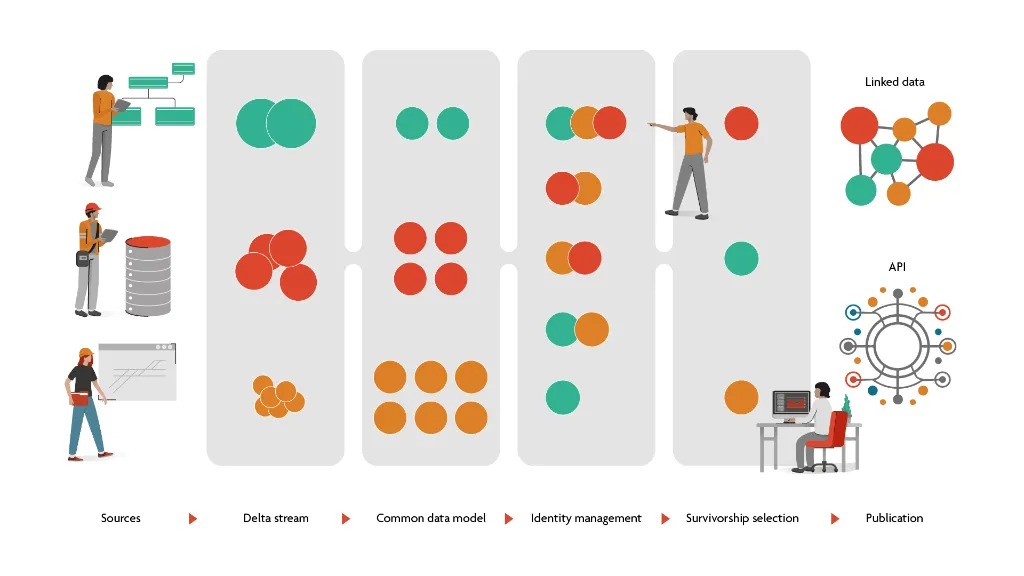
We start by ingesting raw data from your existing landscape. Whether it's your Net Declaration, GIS, ERP, Excel sheets, or legacy databases, we extract the data as-is, ensuring no information is lost at the source.
Convert to Delta Streams
Raw data is converted into Delta Streams. This treats data changes as a continuous stream of events (inserts, updates, deletes) rather than static snapshots. This allows for real-time processing and historical replayability.
Linked Data Model (RINF Ontology)
We map the streams to the RINF Ontology. By using Linked Data standards (RDF), we ensure the data is semantically rich and compliant with the ERA definitions from day one.
Identity Mapping
Different systems call the same asset by different names. We implement Identity Mapping to resolve these aliases into a single, canonical URI. We automate the 'easy' matches, while a modern Web UI allows data stewards to easily resolve difficult cases.
Survivorship Selection
When sources conflict (e.g., GIS vs SAP), who wins? We define Survivorship Rules to automatically select the best data point for 'easy' cases. For complex conflicts, the same modern Web UI enables experts to decide the "Golden Record."
Output
Finally, the governed data is published.
- RINF Submission: Direct Graph Submission to ERA.
- Delta Streams: Clean data fed back to internal systems.
- Knowledge Graph: Queryable endpoint for analytics.
Proven in Production
This isn't theoretical. Our pipeline architecture runs daily at a major European infrastructure manager:
5+
Data sources integrated
20K+
Assets under management
Daily ingests with full lineage and audit trail. Identity resolution, conflict handling, and schema evolution—solved.
Understanding Your Data Inputs
Not all data is created equal. Learn how we distinguish between Static Inventories, Future Projects, and Field Measurements to build a robust master data architecture.
Read: 3 types of Asset InformationA Foundation for the Future
This isn't just a RINF converter. It's a modern Asset Master Data Management architecture. By adopting this roadmap, you solve compliance and modernization in one go.
Discuss this Architecture